
Private English Lessons with Personalised Teaching
Fluency is built through consistent practice, not lessons alone. Reaching English fluency can take 600-750 hours of one-to-one online tutoring combined with self-practice. Private English lessons can give you focused guidance, while regular practice helps you use what you learn.
Your timeline depends on your starting level, goals, lesson frequency and time for practice. Whether you need English for work, study, travel or everyday conversation, a personalised plan can focus on the skills you’ll use most.
This guide explains how to find private English lessons in Kenya, choose a format that suits your needs and practise grammar, vocabulary, pronunciation, reading, writing and speaking with purpose. You’ll also learn how to compare lesson options and make a practical choice that fits your schedule and supports steady progress.
Key Takeaways
- Compare tutors by teaching experience, lesson focus and fit for your needs, not just their listed rate.
- Set a clear learning goal and preferred learning approach so lessons can focus on what matters to you.
- Build practice across speaking, listening, reading, writing, pronunciation, vocabulary and grammar.
- Plan lesson times and locations around your routine, then agree on a practical way to stay consistent.
- Choose general, business or academic English based on where you need to use the language.
Where can I find an English tutor?
Across Kenya, you can compare tutor profiles through online listings and learning providers. Check each profile for teaching experience, lesson format, learner level and fit with your communication goals.
Finding and Filtering Tutor Listings
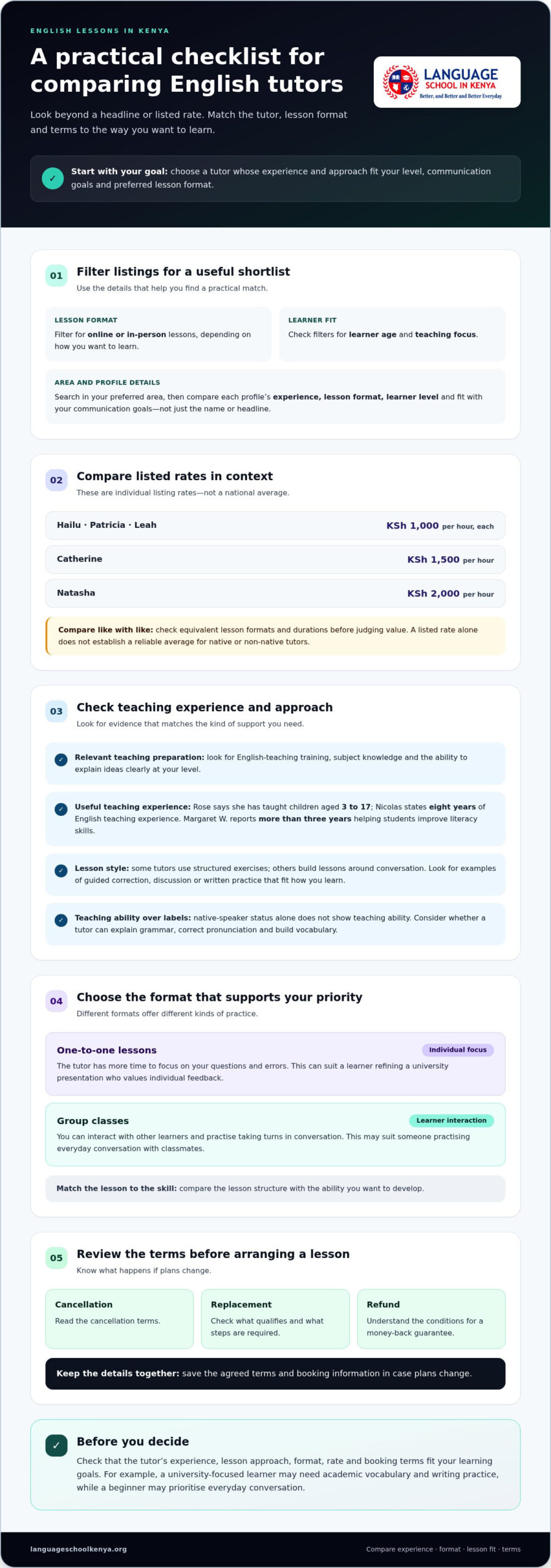
Use filters for online or in-person lessons, learner age and teaching focus. Search for English tutors in your preferred area, then compare profile details rather than relying on a headline or name. Tutor listings include profiles such as Hailu, Patricia, Leah, Natasha and Catherine, with different stated rates and experience.
Before arranging a lesson, read the cancellation, replacement and refund terms. A replacement or money-back guarantee is useful only if its conditions explain what qualifies and what steps you must take. Keep the agreed terms and booking details together in case plans change.
How do I choose a qualified private English tutor? Match the tutor’s experience and teaching approach to your level, goals and preferred lesson format. For example, someone preparing for university study may need academic vocabulary and writing practice, while a beginner may prioritise everyday conversation.
Tutor Rates and Teaching Experience
Listed tutor rates vary. Hailu, Patricia and Leah are listed at KSh 1,000 per hour; Catherine is listed at KSh 1,500 per hour, and Natasha at KSh 2,000 per hour. These are individual listing rates, not a national average. Compare equivalent lesson formats and durations before judging value.
Native-speaker status alone doesn’t show teaching ability, and listed rates don’t establish a reliable average for native or non-native tutors. Consider experience, lesson structure and whether the tutor can explain grammar, correct pronunciation and build vocabulary. Rose says she has taught children aged 3 to 17, while Nicolas states eight years of English teaching experience.
Teaching styles differ. One tutor may favour structured exercises, while another builds lessons around conversation. Look for profile examples that match how you learn, such as guided correction, discussion or written practice.
Qualifications and Lesson Format
What qualifications should an English tutor have in Kenya? Look for relevant English-teaching training, evidence of teaching experience and an approach suited to your needs. Consider subject knowledge as well as the ability to explain ideas clearly and support learners at your level.
How can I compare one-to-one English lessons with group classes? One-to-one lessons give the tutor more time to focus on your questions and errors. Group classes let you interact with other learners and practise taking turns in conversation.
Choose the format that supports your priority. A learner refining a university presentation may value individual feedback, while someone practising everyday conversation may prefer speaking with classmates. Compare the lesson structure with the skill you want to develop.
Personalised teaching based on goals and learning style
A useful learning plan starts with a clear goal, such as speaking confidently at work or improving reading. Your preferred pace, current English skills and daily routine should shape how lessons are taught.
Learning Plans and Flexible Schedules
Before lessons begin, identify what you want to do in English and where you need support. Someone preparing for workplace discussions might practise speaking and useful vocabulary, while a learner focused on writing can work through drafts and feedback. Share which activities help you learn, such as conversation, written exercises or listening tasks.
Agree on lesson times that fit your routine and a way to review progress. If work shifts change, discuss a schedule that can adapt while keeping your learning goal in view. With private English lessons, activities can focus on your questions and change as your skills develop.
A tutor who speaks your native language may clarify a difficult instruction or grammar point. However, lessons should still give you opportunities to use English. Try discussing a familiar topic in English, then use a brief explanation in another language if it resolves confusion. This can help you understand the task without replacing speaking practice.
For example, a Kiswahili-speaking learner might compare an English sentence with a familiar structure, then practise using the English form in conversation. Consider whether language support helps you return to English with greater understanding. Choose an approach that encourages participation rather than translating every sentence.
Lessons for Different Age Groups
Children, teens and adults have different interests and learning needs. A child may respond well to stories, pictures and short speaking activities, while a teenager may prefer discussions about school or hobbies. Adults can focus practice on workplace conversations, travel or everyday tasks.
Literacy support should reflect the learner’s needs. Margaret W. reports more than three years of experience helping students improve literacy skills. For someone who finds reading challenging, a tutor can use short passages, clear instructions and gradual writing practice, adjusting activities to the learner’s responses.
When choosing a learning style, ask for a practical example of a lesson activity. A visual learner might label objects and build vocabulary; someone who learns through discussion could describe a daily routine and receive corrections. Examples make it easier to judge whether lessons will feel engaging and useful.
For learners seeking structured English study, English learning options offer another path to consider. With private English lessons, make your goals, preferred learning approach and schedule clear from the first lesson, so your practice has a useful direction.
Grammar, vocabulary, pronunciation, writing, reading and speaking practice
English practice works best when each activity supports a clear communication goal. For example, prepare for a work meeting by combining vocabulary, speaking and short writing tasks.
Grammar and Vocabulary Development
Build grammar and vocabulary through examples you can use straight away. If you’re learning past-tense forms, describe what you did yesterday, then review the verb choices with your tutor. Record useful expressions in a vocabulary list and use each in a new sentence. This connects grammar rules with active language skills.
Reading and writing can reinforce the same lesson. Read a short news item, identify unfamiliar words, then write a brief summary using them. Your tutor can point out sentence structure, word choice and errors that affect meaning. Keeping corrected versions helps you notice patterns and decide what to practise next.
English is an official language in 67 countries, so learners encounter varied accents and communication settings. Rather than memorising long word lists, group vocabulary by purpose: introductions, giving directions or describing a product. For example, practise “Could you clarify that?” in a workplace exchange, then use it in your own conversation.
Pronunciation and Conversation Practice
Pronunciation practice can focus on sounds that change meaning, word stress and clear pacing. Read a short sentence aloud, listen to the tutor’s model, then repeat it while noticing the stressed words. For example, practise a name or place you often need to say at work. The aim is clearer communication, not copying a particular accent.
Use conversation tasks to practise responding, not just memorising prepared lines. A tutor can play a customer, colleague or university interviewer while you explain a problem or ask follow-up questions. After each exchange, review one pronunciation point and one phrase to improve. Specific feedback gives you another chance to try.
Reading aloud connects pronunciation with comprehension. Choose a short passage, mark pauses at punctuation and read it again with natural phrasing. Then explain its main point in your own words. English tutors can use this sequence to identify whether you need support with vocabulary, sentence meaning or speaking confidence.
To make steady progress, keep a simple record after each lesson: note one grammar point, three useful words and one speaking task to repeat. For example, write a short email using the new vocabulary, then practise explaining its message aloud. Reviewing your notes before the next lesson makes improvement a practical routine.
Contacting teachers and arranging lesson times and locations
A clear first message helps you compare teaching approaches, timetables and lesson formats. Share your English goal, preferred format and available times so tutors can respond with relevant options.
Are online private English lessons available in Kenya? Yes, online English lessons are available in Kenya. They can suit learners who prefer studying from home or want to reduce travel, while in-person teaching may work better for those who value meeting a tutor face to face.
Use listing filters to narrow your search before contacting tutors. Select online or in-person teaching, learner level and relevant experience. If you need speaking practice for work, look for profiles that describe conversation activities. For lessons for a child, prioritise tutors with relevant experience teaching young learners.
Check timetable details in each profile, then send a focused message. For example: “I’m improving workplace English and can study after work. Do you teach online, and what lesson times do you offer?” This gives a tutor useful context and helps you compare responses and see whether the times fit your routine.
Before agreeing, settle the practical details in writing. Confirm the lesson format, meeting location or online platform, start time, cancellation terms and how you’ll share learning materials. For an in-person lesson, choose a location convenient for both learner and tutor. For online teaching, find a quiet place and test your audio before the session.
Native and bilingual tutors can bring different strengths to teaching. A native English speaker may offer exposure to natural phrasing, while a bilingual tutor can explain a difficult point in a language you understand. Choose based on your goal. For example, a learner building confidence may prioritise patient speaking practice over the tutor’s first language.
Ask how the tutor structures classes and tracks progress. A dedicated tutor might have a short conversation, note recurring errors and plan the next activity around them. That makes your first exchange useful: you can understand the teaching style before agreeing to a timetable.
When comparing replies, consider more than convenience. A flexible schedule matters, but regular attendance also supports learning. If a proposed time conflicts with work or school, suggest another slot and ask whether online lessons could make attendance easier. Choose an arrangement you can maintain alongside your commitments.
General, business and academic English
Choose lesson content based on where you need English most. General English supports everyday communication, while business and academic practice focus on specific tasks, vocabulary and writing styles.
For general English, start with situations you encounter regularly. You might practise greeting a neighbour, asking for directions in Nairobi or explaining a problem at a shop. A tutor can use each scenario to combine grammar, vocabulary and conversation, then help you make your meaning clearer. This approach gives each class a practical purpose.
Business English focuses on communication at work. Bring a real task, such as writing a polite email, giving a project update or clarifying a deadline. Practise useful phrases, then adapt them for a conversation with a colleague or client. Learners preparing for an interview can rehearse a concise introduction, explain their experience and answer questions about their skills.
After a practice interview, review whether each answer addresses the question directly. For example, describe a work challenge, explain the action you took and state the result. A tutor can help refine grammar, tone and word choice. This prepares you to communicate clearly without relying on memorised answers that may not fit the interviewer’s questions.
Academic English supports tasks connected to school, university or further study. A learner might practise taking notes from a short lecture, summarising a reading or organising an essay. Lessons can focus on formal vocabulary, paragraph structure and linking ideas. If you need to present research, practise explaining the main point aloud before adding supporting details.
Online English lessons can work well for learners balancing study with other commitments. Use a draft essay, meeting agenda or class reading as lesson material. Before the session, identify one task you want to improve. Afterwards, revise the same work using the tutor’s feedback. This creates a clear practice cycle for each lesson.
To choose a focus, list the situations where you use English and rank them by importance. If an upcoming job interview matters most, prioritise speaking and interview answers. If a university assignment is your immediate challenge, bring the instructions and your draft. A defined task makes lessons relevant and progress easier to review.
Want structured English learning in Nairobi? Explore English learning options and choose a direction that fits your study, work or everyday communication goals.
The Language School in Kenya (École de Langues du Kenya): English Courses in Nairobi
The Language School in Kenya (École de Langues du Kenya) offers English Courses for learners who want structured language teaching. Practical lessons, small-group classes and flexible schedules can support study alongside work or other commitments. Bring a clear goal, such as speaking more confidently at work, improving everyday conversation or strengthening academic English, to help focus your learning.
If you’re also interested in learning another language, the school offers French classes, Spanish classes and German language classes. These options can suit learners building communication skills for personal, study or professional reasons.
To discuss English learning, contact The Language School in Kenya (École de Langues du Kenya), or visit languageschoolkenya.org.
Take the next step towards confident English
Your next move can be simple: choose one situation where you want to communicate more comfortably, then make it the focus of your learning. It could be contributing to a meeting, speaking with a customer or expressing your ideas in class. A clear starting point helps you decide what guidance will be useful and gives you something practical to work towards.
If you’re looking for structured English learning in Nairobi, The Language School in Kenya (École de Langues du Kenya) offers English Courses in Nairobi. You can also explore its French classes and Spanish classes if another language fits your personal or professional interests. Private English lessons may suit learners seeking one-to-one attention, while a course can provide a structured way to develop language skills.
Choose the path that fits your goals and schedule, then take the first step at your pace. Contact The Language School in Kenya (École de Langues du Kenya) to discuss your learning goals and explore your options. With a clear purpose and regular practice, you can keep building confidence one conversation at a time.
Frequently Asked Questions
How Soon Can I Become Fluent In English?
Fluency can require 600-750 hours of one-to-one online tutoring combined with self-practice. Your starting level, learning goals, lesson consistency and independent practice all affect how quickly you progress. For example, a learner who practises conversations between lessons gets more chances to use new expressions. Treat fluency as a developing ability, and set smaller milestones, such as explaining an idea clearly or following a work discussion.
Are the English classes and courses suitable for beginners?
Yes, English learning can start with foundational skills, including everyday vocabulary, simple sentence patterns and basic conversation. A beginner might first practise introducing themselves, asking for directions or describing a daily routine. Before starting, identify situations where you need English and share them with your teacher. This gives lessons a practical starting point and helps you notice progress in tasks that matter outside class.
Is it worth getting an English tutor?
An English tutor can be worthwhile if you need focused feedback or want help working towards a specific goal. For example, a learner who understands written English but hesitates during meetings can use lesson time for speaking practice and feedback. Tutoring also suits people who want to ask questions as they arise. Consider whether individual guidance addresses a need that self-study alone isn’t meeting.
Where can I find private English tutors in Kenya?
You can find tutors through online listings and learning providers offering English teaching across Kenya. Search by preferred format and learner level, then compare profiles for relevant experience, teaching approach and lesson details. Contact a shortlist with the same description of your goal, such as preparing for customer conversations. Comparing replies makes differences in teaching style and scheduling easier to assess.
How much do private English lessons cost in Kenya?
The cost depends on factors such as lesson length, format, tutor experience and teaching focus. For a fair comparison, consider what each arrangement includes and whether its structure suits your goal. A focused session for interview preparation may differ from ongoing general-English tuition. For courses from a learning provider, the price depends on the case and is given after a quote request.
What is the average hourly rate for English tutoring in Nairobi?
There isn’t one hourly rate that represents every English tutor or lesson arrangement in Nairobi. Rates depend on the tutor, lesson format, session length and learning focus. Compare options with the same requirements, such as one-to-one online teaching for workplace conversation, rather than comparing unlike listings. For a course from a learning provider, the price depends on the case and is given after a quote request.
Are private English lessons available for children, students, and adults?
Yes, English teaching can be arranged for children, school or university students, and adults. Lesson activities should match the learner’s age and daily needs. A child might practise describing pictures, while a university student could work on understanding assignment instructions. An adult may focus on explaining responsibilities to colleagues. Share the learner’s interests and goals so activities feel relevant and manageable.
What should I expect in a private English lesson?
Expect a session focused on your learning needs, with time to practise and receive feedback. A lesson might begin with a short conversation, move into a task such as writing a message, then review useful corrections. You can also bring a real challenge, such as understanding a school notice or preparing to speak with a colleague. Arrive with a goal or question to make the session purposeful.