
English Classes in Kenya for Study, Work and Daily Communication
An accredited label alone won’t tell you whether an English course fits your goals. English classes in Kenya can help you build the skills you need for study, work, interviews and everyday conversations, and these classes are for learners aged 16 and older. The right choice depends on your current level, what you want to do in English, and the way you prefer to learn.
When comparing English classes in Kenya, look beyond the course label: level, format, and practical learning goals all matter. Beginners need a different starting point from learners preparing to communicate confidently at work or in further study.
This guide explains how course levels and formats can suit different needs, who can attend, and how lessons can support communication in real situations. It also covers what to consider when choosing a course, so you can identify a practical next step that fits your goals and routine.
Key Takeaways
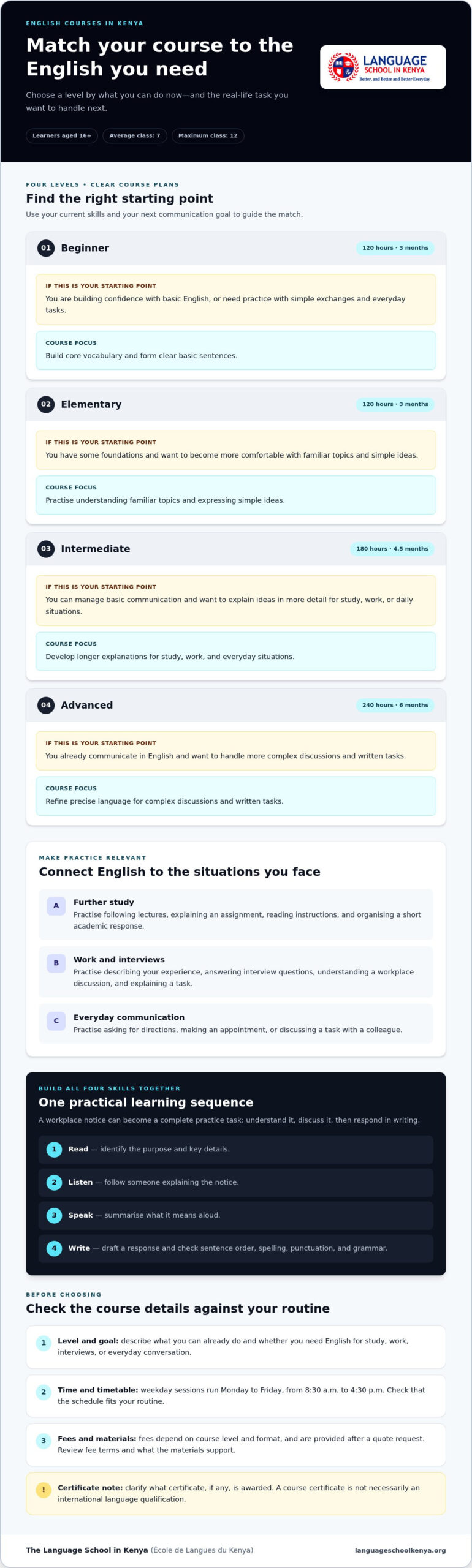
- Classes are for learners aged 16 and older, with an average class size of 7 and a maximum of 12 students.
- Match your starting level to your current skills and goals; course lengths range from 120 hours over 3 months to 240 hours over 6 months.
- Practise speaking, writing, listening and reading to build skills you can use in study, workplace communication, interviews and daily life.
- Compare learning formats against your schedule and preferred way of practising; classes run Monday to Friday from 8:30 a.m. to 4:30 p.m.
- Use the application guidance to understand the key considerations before choosing a course and planning your next step.
Who Should Attend this English Speaking Course?
English study can suit adults building confidence for practical communication, further study, or work. These classes are for learners aged 16 and older. Your starting point should reflect what you can already do. For example, can you introduce yourself, follow simple directions, and write a short message? Those tasks help identify whether beginner-level practice or more advanced work is a better fit.
Choose learning goals based on situations you actually face. A university applicant may need to follow lectures and explain an assignment. Someone seeking work may want to describe their experience clearly in an interview. For everyday communication, useful practice might include asking for directions, making an appointment, or discussing a task with a colleague. Specific situations make lessons easier to apply outside class.
Good practice connects speaking, listening, reading, and writing rather than treating them as separate skills. For example, read a short workplace notice, listen to someone explain it, summarise its meaning aloud, then write a response. This sequence reveals whether the challenge is vocabulary, grammar, understanding spoken English, or organising ideas. A class averaging 7 students, with a maximum of 12, can also give learners opportunities to contribute and receive feedback.
- Speaking: Practise introducing yourself, giving directions, and explaining a simple problem. Then repeat the task with clearer details and more precise words.
- Listening: Listen for the main point in a short conversation. For example, identify a meeting time, a requested task, or a change to an appointment.
- Reading: Work through a notice, email, or short article. Identify its purpose, key details, and any action the reader needs to take.
- Writing: Draft a message or short explanation, then check sentence order, spelling, punctuation, and grammar before sharing it.
Beginners can start with basic writing skills for everyday tasks. Practise writing a complete sentence, filling in a simple form, and composing a clear message such as, “I will arrive after lunch.” Then check capital letters, full stops, verb choice, and whether the main point is clear. These small steps build a foundation for longer writing assignments.
Academic writing calls for a different approach from a quick text message. Learners preparing for university can practise outlining a short response, stating its main idea, and supporting it with relevant examples. Then revise the paragraph order, grammar, and links between ideas. Reading a course notice or textbook extract can also build vocabulary for understanding instructions and taking useful notes.
Choose a course that focuses on the skill you need most while still practising all four language skills. If interviews are your priority, practise spoken answers, listening to follow-up questions, and writing notes about your examples. If study is your goal, pair reading and academic writing with discussion. This focused practice connects English learning to real situations.
English courses for different proficiency levels
Compare English classes in Kenya by class size, timetable, and instructor qualifications. Regular Classes average 7 students, with a maximum of 12; weekday sessions run from 8:00 a.m. to 4:30 p.m., Monday to Friday, and instructors are experienced and certified through The Language School in Kenya (École de Langues du Kenya).
Choose a course level that matches your current English proficiency and the tasks you want to manage. Beginner courses build basic vocabulary, sentence structure, and confidence in simple exchanges. Elementary study extends those foundations, while intermediate and advanced courses support more detailed communication. To identify a suitable starting point, describe what you can already do, such as write a short email or follow a workplace discussion.
Course duration varies by level. Beginner and Elementary Effective English courses each run for 120 hours over 3 months. The Intermediate Effective English course runs for 180 hours over 4.5 months, while Advanced Effective English runs for 240 hours over 6 months. These course plans give learners a defined period for practice and progress.
- Beginner: Build core vocabulary and form clear basic sentences.
- Elementary: Practise understanding familiar topics and expressing simple ideas.
- Intermediate: Develop longer explanations for study, work, and everyday situations.
- Advanced: Refine precise language for complex discussions and written tasks.
Before applying, identify your goal and current level. Explain whether you need English for university tasks, workplace communication, interviews, or everyday conversations. A short discussion of your experience can help match course objectives to your needs. For example, if you understand written instructions but struggle to speak, prioritise spoken practice.
Before paying for an English course in Kenya, review the level, total duration, timetable, fee terms, materials, and certificate details. Ask for a clear breakdown of what the fee covers, and make sure the schedule fits your routine. Fees depend on the course level and format, and are provided after a quote request.
Course materials should support the skills being taught. For academic writing, for example, useful materials include reading passages, writing prompts, and opportunities to revise your work. Check how practice materials relate to course objectives, and clarify what certificate, if any, you receive upon completion. A course certificate is not necessarily an international language qualification.
For a practical comparison, note your current strengths, target situations, available study times, and preferred level of instructor feedback. Then compare course outlines against those priorities. Reviewing English course level options can help you identify a suitable learning path.
English for university, work, interviews and daily communication
English communication needs vary by situation. At university, learners may need to follow a lecture, contribute to a discussion, and organise assignment ideas. At work, they may need to explain a task, clarify instructions, or write a concise update. Interview practice helps learners describe their experience clearly and answer questions directly.
For IELTS, TOEFL, or Cambridge exams, choose an exam-focused course that practises reading, listening, writing, and speaking tasks. Preparation develops relevant English skills, while exam administration and international certification are separate matters.
Training is most useful when each exercise reflects a real communication goal. Try these activities to connect grammar, vocabulary, and interpersonal skills:
- University: Summarise a short reading, then explain its main idea aloud. Practise linking examples to a clear point.
- Work: Give a colleague a brief progress update. Include the task, its status, and the next action.
- Interviews: Answer a question about your experience using a specific example. Then practise listening for follow-up questions before responding.
- Everyday situations: Role-play asking for directions, making an appointment, or explaining a misunderstanding. Clear, polite phrasing supports smoother exchanges.
Grammar supports communication when it helps listeners understand your meaning. For example, using past-tense verbs consistently makes a description of previous work easier to follow. Practise correcting one issue at a time, such as verb tense, word order, or articles. Then repeat the explanation with the correction in place.
Interactive speaking practice also builds interpersonal skills. In a paired discussion, take turns asking questions, listening without interrupting, and responding to the other person’s point. A useful sequence is to state an idea, give a reason, and invite a response. This structure works in a classroom discussion or workplace meeting.
For daily communication, focus on the purpose behind a message. If someone says, “Could you send the file today?”, identify the request and timing before replying. Practise confirming details in your own words, such as, “I’ll send the report this afternoon.” This brief response checks understanding and keeps the exchange clear.
Choose practice based on your next real task. A student can rehearse explaining an assignment, while a job seeker can practise a concise introduction. Repeated speaking, listening, and grammar exercises help learners build skills they can use in study, work, and everyday situations.
Online, self-paced, classroom, and onsite learning formats
In Nairobi, English classes run Monday to Friday from 8:30 a.m. to 4:30 p.m. Learners in other Kenyan cities can consider online learning, while choosing a format that supports regular practice, pronunciation, and listening.
Classroom, Onsite, and Blended Formats
Classroom learning offers direct interaction, live speaking practice, and immediate answers to questions. Onsite training can bring lessons to a workplace or another agreed setting, which may suit practical team communication. Blended learning combines in-person sessions with online activities. Compare formats by travel needs, access to instructor feedback, and time for independent practice.
Online lessons can connect learners outside Nairobi with a teacher and classmates, depending on the course format. They work best when learners have a suitable device, reliable internet access, and a quiet space for speaking exercises. For example, a learner can join a live discussion, practise pronunciation, then review vocabulary between lessons.
Self-paced learning gives you control over when to study, but it requires a consistent routine. Set aside time to listen to a short recording, repeat difficult phrases, and complete a grammar activity. This format can support revision, though independent study offers less spontaneous conversation than a live class.
Nairobi Centre and Weekday Schedule
In Nairobi, the weekday timetable runs from 8:30 a.m. to 4:30 p.m., Monday to Friday. Before selecting a class, compare its session timing with work, study, and travel commitments. A learner who can attend during those hours may benefit from in-person speaking practice, while someone outside the city may prefer online study.
English courses are available in Nairobi; learners in other Kenyan cities can consider online study as a way to access learning remotely. When comparing options, look at how sessions are delivered, how often learners speak, and whether listening and pronunciation receive active practice. These details reveal whether a format suits your location and learning habits.
Learning outcomes depend partly on what students practise and how they review feedback. Set a specific goal, such as explaining a work process clearly or understanding spoken instructions. Then track progress by repeating a similar task and noticing changes in clarity, word choice, and confidence. This gives you a practical way to judge whether the format supports your needs.
- For live interaction: Choose classroom or online sessions with discussion and instructor feedback.
- For schedule control: Use self-paced activities to review vocabulary and listening practice.
- For varied practice: Consider blended learning that combines lessons with independent tasks.
Student satisfaction is easier to assess through specific learning experiences than broad promises. Notice whether you can ask questions, practise relevant situations, and understand feedback. If pronunciation is a priority, include spoken exercises and opportunities to hear corrections. If you need listening practice, look for activities using conversations, instructions, or short presentations.
Before choosing, consider your location, available study time, and preferred level of instructor interaction. For example, someone with weekday availability may choose classroom sessions, while a learner who needs to study remotely may prefer online lessons. A format that fits these practical needs makes it easier to prepare consistently and use new English skills beyond class.
Application requirements
Start by matching your course choice to a clear goal. Note whether you want to contribute to university discussions, communicate at work, or manage everyday conversations. This helps you explain what you hope to practise and choose a suitable starting level. A learner who can read simple messages but struggles to speak may need different support from someone preparing academic writing.
Before applying, prepare a short description of your current English skills. Include examples, such as following spoken instructions, writing a brief email, or introducing yourself in a meeting. These details clarify your learning priorities. You can also note which situations feel difficult, so your course choice addresses practical needs rather than a general wish to improve.
Use this checklist to organise your next steps:
- Set a goal: Choose one outcome, such as explaining your work experience clearly.
- Describe your current level: Give an example of a task you can complete and one that challenges you.
- Choose a format: Compare classroom learning with online study against your location and routine.
- Plan your schedule: Check whether weekday lessons fit around work, study, and travel.
- Ask about course details: Review the level, duration, learning objectives, materials, and certificate terms before paying.
For example, a job seeker can list common interview situations and practise a short introduction. A university applicant might bring a sample paragraph to identify writing goals. These examples make an initial discussion more focused and help distinguish pronunciation, grammar, vocabulary, or listening needs without assuming every learner starts at the same level.
Course decisions should include practical arrangements, not only learning goals. Compare the timetable with your weekly commitments, and consider how you will travel or connect online. If you are considering a Nairobi weekday class, its schedule runs Monday to Friday from 8:30 a.m. to 4:30 p.m. Choose a plan that lets you attend and practise consistently.
Review course terms carefully before making payment. Confirm what the fee covers, how learning materials are provided, and what the completion document represents. A course certificate and an international language qualification are not the same thing. Clear expectations support confidence and help you use your English effectively, whether communicating locally or in global study and work settings.
Accuracy improves through a simple routine: set a goal, practise a relevant task, then review feedback. For instance, write a work email, check its grammar, and read it aloud for clarity. To take the next step, begin your English course application with your goals and preferred schedule in mind.
The Language School in Kenya (École de Langues du Kenya): English Courses in Nairobi
The Language School in Kenya (École de Langues du Kenya) offers English Courses in Nairobi for learners building communication skills for study, work, interviews, or everyday situations. If you’ve identified your current level and learning goals, the next step is choosing a course that aligns with them. Experienced, certified instructors, small-group classes, and flexible schedules support practical learning and regular participation.
Consider what you want to do more confidently in English. You might need to contribute to discussions, communicate with colleagues, or handle daily conversations. The school also offers French classes, Spanish classes, and German language classes in Nairobi for learners pursuing another language.
Contact The Language School in Kenya (École de Langues du Kenya) to discuss your English learning goals.
Turn Your English Goals Into a Practical Next Step
Choose a communication task you want to handle more effectively, then use it to guide your learning. You might aim to explain an idea clearly, contribute to a discussion, or pursue a professional opportunity with greater confidence. A specific goal gives your practice purpose and helps you notice your progress.
The Language School in Kenya (École de Langues du Kenya) offers English Courses in Nairobi for learners developing practical communication skills. If you’re also interested in another language, its offerings include French classes and Spanish classes in Nairobi. Consider which language best supports your personal, academic, or professional plans, then take the next step at a pace that suits your priorities.
To discuss your learning goals and explore a suitable course, contact The Language School in Kenya (École de Langues du Kenya). Your next conversation can help turn an intention into a clear plan. With focused practice and a course aligned with your aims, you can keep building skills for study, work, and everyday life.
Frequently Asked Questions
Looking for an Accredited English College in Kenya?
Accreditation and teaching quality are separate points to consider before enrolling. Ask which body accredits a course, what qualification it awards, and whether that award serves your study or employment goal. The Language School in Kenya (École de Langues du Kenya) offers language training with experienced, certified instructors. Instructor credentials can help you assess teaching expertise, while course outcomes show whether lessons address practical communication needs.
Who Should Enrol?
English courses suit learners aged 16 and older who want to develop communication for study, work, interviews, or daily tasks. A learner preparing for university might focus on understanding instructions and expressing ideas; someone seeking work may practise explaining experience clearly. Before choosing, note one situation where English feels challenging and one task you already manage, such as reading a short message.
What Types of English Classes Are Available in Kenya?
English classes in Kenya vary by proficiency level, delivery format, and learning goal. Options include beginner through advanced study, group or individual lessons, and online or in-person learning. A learner seeking more speaking practice might prefer live interaction, while someone reviewing vocabulary can add independent exercises. Compare course objectives with your needs, such as writing for university or communicating with colleagues.
Which English Schools and Language Centres in Kenya Are Reputable?
Look for clear course objectives, qualified instructors, transparent terms, and practice connected to real communication needs. The Language School in Kenya (École de Langues du Kenya) describes its instructors as experienced and certified, and its courses as practical. Compare a course outline with your goals, such as preparing for workplace discussions or improving everyday conversation.
How Much Do English Classes in Kenya Cost?
The price depends on the course level and format, and is provided after a quote request. Group or individual lessons, course duration, and the learning plan affect the overall cost. Before committing, ask for a breakdown of what the fee covers, including materials and any completion document. Compare the course structure with your goals to judge its value, not just its total fee.
Are There Free or Affordable English Classes in Kenya?
Paid courses are available in different formats, including group and individual learning. To manage your budget, compare the instructor interaction and course structure each format provides. You can also add practice to daily routines without buying materials, such as reading public notices, writing a short journal entry, or practising a conversation with a willing partner. These activities supplement, rather than replace, structured lessons.
What Are the Entry Requirements and Enrollment Steps for English Classes in Kenya?
English classes in Nairobi are for learners aged 16 and older. Start by identifying your communication goal, describing your current skills, and choosing a suitable course level and format. Then review the course schedule, duration, fee terms, materials, and certificate details before enrolling. For example, mention whether you can follow spoken instructions but need practice writing clear work messages.
How Long Do English Courses in Kenya Take, and What Proficiency Levels Are Offered?
Course duration depends on proficiency level: Beginner and Elementary Effective English each run for 120 hours over 3 months; Intermediate runs for 180 hours over 4.5 months; Advanced runs for 240 hours over 6 months. These options span foundational language practice through more complex communication. Choose according to your current skills and the tasks you want to handle, such as study discussions or detailed workplace explanations.